human-logic
Human Logic or Common Sense


Human Logic (also known as “common sense”) is based on five categories:
true= certainly positivefalse= certainly negativemaybe= uncertain (could be either positive or negative)never= impossible (neither positive nor negative)undefined= totally unknown
This package provides the implementation of both Discrete Common Sense Logic and Fuzzy Common Sense Logic.
Discrete Common Sense Logic only allows true, false, maybe, never or undefined as a value.
In Fuzzy Common Sense Logic the value is five-dimensional unit vector. Each vector component is a fuzzy value (between 0.0 and 1.0 inclusive) of respective true, false, maybe, never or undefined category.
Migration from v1 to v2
Categorytype was migrated from numeric enum tostringconst assertionsCategorytype valuesUNDEF,FALSE,NEVER,MAYBE,TRUEare now strings (not numbers).LogicHashinterface was removed – useLogicValuesinterface instead.Logic.asHash(...)was removed – useLogic.asValues(...)instead.Logic.fromHash(...)was replaced by new methodLogic.fromValues(...).
Documentation
API Documentation: https://timashev.dev/human-logic
Installation
With NPM:
npm install --save human-logic
With Yarn:
yarn add human-logic
Usage
Node v6+ syntax:
const {
// Discrete Common Sense Logic
Categories, UNDEF, FALSE, NEVER, MAYBE, TRUE,
// Fuzzy Common Sense Logic
Logic,
// Polymorphic Functions
not, and, or, normalize,
// Bonus: classical fuzzy logic
Fuzzy, FUZZY_TRUE, FUZZY_FALSE
} = require('human-logic');
ES5+ syntax:
import {
// Discrete Common Sense Logic
Categories, UNDEF, FALSE, NEVER, MAYBE, TRUE,
// Fuzzy Common Sense Logic
Logic,
// Polymorphic Functions
not, and, or, normalize,
// Bonus: classical fuzzy logic
Fuzzy, FUZZY_TRUE, FUZZY_FALSE
} from 'human-logic';
Discrete Common Sense Logic
Math Background
NOT
undef |
false |
never |
maybe |
true |
|---|---|---|---|---|
undef |
true |
maybe |
never |
false |
AND
undef |
false |
never |
maybe |
true |
|
|---|---|---|---|---|---|
undef |
undef |
undef |
undef |
undef |
undef |
false |
undef |
false |
false |
false |
false |
never |
undef |
false |
never |
false |
never |
maybe |
undef |
false |
false |
maybe |
maybe |
true |
undef |
false |
never |
maybe |
true |
OR
undef |
false |
never |
maybe |
true |
|
|---|---|---|---|---|---|
undef |
undef |
undef |
undef |
undef |
undef |
false |
undef |
false |
never |
maybe |
true |
never |
undef |
never |
never |
true |
true |
maybe |
undef |
maybe |
true |
maybe |
true |
true |
undef |
true |
true |
true |
true |
Usage
not(TRUE)
// => FALSE
and(MAYBE, NEVER)
// => FALSE
or(MAYBE, NEVER)
// => TRUE
Categories
// => [UNDEF, FALSE, NEVER, MAYBE, TRUE]
Fuzzy Common Sense Logic
Math Background
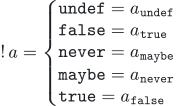
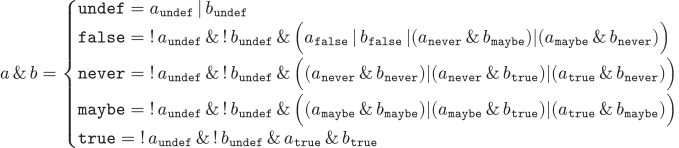
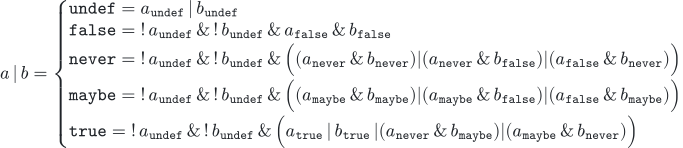
where " ", "
", " " and "
 " are classical fuzzy logic operations.
Initialization
// new instance
const value = new Logic(0.1, 0.2, 0.3, 0.1, 0.4);
// or
const value = Logic.fromValues({
UNDEF: 0.1,
FALSE: 0.2,
NEVER: 0.3,
MAYBE: 0.1,
TRUE: 0.4 // — dominating category
});
// or
const value = Logic.fromArray([0.1, 0.2, 0.3, 0.1, 0.4]);
// Result
value.asCategory()
// => TRUE
value.get(NEVER)
// => 0.3
value.isValid() // At least one category fuzzy value is non-zero
// => true
value.eq(TRUE) // Equal to category
// => true
value.ne(MAYBE) // Not equal to category
// => true
const value = Logic.fromCategory(MAYBE);
value.asArray()
// => [0.0, 0.0, 0.0, 1.0, 0.0]
value.asValues()
// => { [UNDEF]: 0.0, [FALSE]: 0.0, [NEVER]: 0.0, [MAYBE]: 1.0, [TRUE]: 0.0 }
// Cloning
const clonedValue = value.clone();
clonedValue.asValues()
// => { [UNDEF]: 0.0, [FALSE]: 0.0, [NEVER]: 0.0, [MAYBE]: 1.0, [TRUE]: 0.0 }
clonedValue === value
// false
// Normalization
const nonNormalizedValue = Logic.fromValues({
UNDEF: 2,
FALSE: 3,
NEVER: 4,
MAYBE: 5,
TRUE: 6
});
const normalizedValue = nonNormalizedValue.normalize();
normalizedValue.asArray()
// => [0.1, 0.15, 0.2, 0.25, 0.3]
nonNormalizedValue.getNormalized(NEVER)
// => 0.2
Logical NOT
const value = Logic.fromValues({
UNDEF: 0.10, // 10%
FALSE: 0.15, // 15%
NEVER: 0.20, // 20%
MAYBE: 0.25, // 25%
TRUE: 0.30 // 30% — dominating category
});
// Use either class method:
value.not().asValues()
// or polymorphic function:
not(value).asValues()
// => {
// UNDEF: 0.1, // 10%
// FALSE: 0.3, // 30% — dominating category
// NEVER: 0.25, // 25%
// MAYBE: 0.2, // 20%
// TRUE: 0.15 // 15%
// }
Logical AND
const value1 = Logic.fromValues({
UNDEF: 0.15, // 15%
FALSE: 0.10, // 10%
NEVER: 0.25, // 25%
MAYBE: 0.30, // 30% — dominating category
TRUE: 0.20 // 20%
});
const value2 = Logic.fromValues({
UNDEF: 0.20, // 20%
FALSE: 0.30, // 30% — dominating category
NEVER: 0.10, // 10%
MAYBE: 0.15, // 15%
TRUE: 0.25 // 25%
});
// class method
value1.and(value2).asValues()
// polymorphic function
and(value1, value2).asValues()
// => {
// UNDEF: 0.16666666666666669, // ~17%
// FALSE: 0.25, // 25% — dominating category
// NEVER: 0.20833333333333334, // ~21%
// MAYBE: 0.20833333333333334, // ~21%
// TRUE: 0.16666666666666669 // ~17%
// }
Logical OR
// class method
value1.or(value2).asValues()
// polymorphic function
or(value1, value2).asValues()
// => {
// UNDEF: 0.18181818181818182, // ~18%
// FALSE: 0.09090909090909091, // ~9%
// NEVER: 0.22727272727272727, // ~23%
// MAYBE: 0.2727272727272727, // ~27% — dominating category
// TRUE: 0.22727272727272727 // ~23%
// }
Other Operations
Accumulation of fuzzy sums with value normalization in the end:
const values: Logic[] = [
new Logic(0.10, 0.15, 0.20, 0.25, 0.30),
new Logic(0.30, 0.25, 0.20, 0.15, 0.10),
new Logic(0.20, 0.25, 0.30, 0.10, 0.15),
new Logic(0.15, 0.20, 0.25, 0.30, 0.10)
];
const sum: Logic = new Logic();
for (let index = 0; index < values.length; index += 1) {
sum.add(values[index]);
}
sum.asValues()
// => {
// UNDEF: 0.75,
// FALSE: 0.85,
// NEVER: 0.95,
// MAYBE: 0.8,
// TRUE: 0.65
// }
sum.normalize().asValues()
// => {
// UNDEF: 0.1875, // 18.75%
// FALSE: 0.2125, // 21.25%
// NEVER: 0.2375, // 23.75%
// MAYBE: 0.2, // 20.00%
// TRUE: 0.1625 // 16.25%
// }
Classical Fuzzy Logic
Math Background



Usage
FUZZY_FALSE
// => 0.0
FUZZY_TRUE
// => 1.0
not(0.67)
// => 0.33
and(0.47, 0.91)
// => 0.47
or(0.75, 0.34)
// => 0.75
normalize(1.66) === FUZZY_TRUE
// => true
normalize(-28.45) === FUZZY_FALSE
// => true
normalize(0.64)
// => 0.64
Optimized Imports
// Discrete Common Sense Logic only
import { Categories, not, and, or, UNDEF, FALSE, NEVER, MAYBE, TRUE } from 'human-logic/dist/Category';
// Fuzzy Common Sense Logic only
import { Logic, not, and, or, normalize } from 'human-logic/dist/Logic';
// When using class methods only
import { Logic } from 'human-logic/dist/Logic';
// Classical Fuzzy Logic only
import { Fuzzy, not, and, or, normalize, FUZZY_TRUE, FUZZY_FALSE } from 'human-logic/dist/Fuzzy';